


sdOB1 (Keele)
SEND QUESTIONS to Veronika Schaffenroth
This email address is being protected from spambots. You need JavaScript enabled to view it.
Hot subluminous stars are objects located between the upper end of the white dwarf cooling sequence and the main sequence in the H-R Diagram. Most are hot subdwarf of spectral type O or B that are either currently fusing helium to carbon in their cores on the extended horizontal branch, or recently stopped core fusion and are evolving towards the white dwarf cooling track. To form such an object the red giant progenitor is stripped close to the tip of the RGB. Several other types of objects also have evolutionary tracks passing through or cross close to this part of the H-R Diagram, including post-AGB sdO stars, pre-extremely low mass white dwarfs, more massive stripped stars, and more. All hot subluminous stars are evolved objects thought to share one common trait: binary interactions are necessary for their formation. Given their formation histories, studies of hot subdwarfs and related objects can provide powerful insights into Roche lobe overflow processes, common envelope evolution, mergers and other interesting astrophysical phenomena. The broader impacts of these studies touch on gravitational wave physics, the survivability of exoplanets, Type Ia supernovae, and more. Current and future large telescopes and surveys have and will continue to expand our knowledge of these intriguing stars—especially in the era of quickly advancing machine learning algorithms and complex statistical methods. The fourth Gaia data release (DR4), scheduled for 2 December 2026, is expected to greatly advance our understanding of hot subluminous stars through more precise parallaxes and proper motions, light curves for many more objects, and an expanded catalogue of astrometric binaries, offering new opportunities to investigate their properties, companions, and evolutionary histories. In 2027, we will also mark the tenth anniversary of the discovery of blue large-amplitude pulsators (BLAPs).
sdOB13 will bring together observational and theoretical work on hot subdwarfs and their progenitors, companions and descendants. It will build on the foundational knowledge from previous meetings by discussing the following key topics:
- Origins and Evolutionary Pathways: Examining both standard and alternative mechanisms behind the formation of hot subdwarfs. .
- Population Studies: Investigating the distribution and characteristics of hot subdwarfs in the field, clusters, and galaxies to understand their formation and evolutionary processes on a broader scale.
- Role in Binary and Multiple Star Systems: Understanding the dynamics and evolution within hot subdwarf systems and the nature of their companions.
- Single sdBs: Investigating the origins of apparently single hot subdwarfs and the roles of mergers and other formation channels.
- Atmospheric Properties: Investigating the unique chemical and physical properties of hot subdwarf atmospheres.
- Pulsation and Asteroseismology: Using stellar pulsations to probe internal structures and test theoretical models.
- Advancements in Stellar Physics: Exploring common envelopes, convection, diffusion, atomic interactions, and tidal effects within hot subdwarfs.
- Connections to Other Stellar Objects: Linking the behavior of hot subdwarfs to that of progenitor, successor, and related systems, such as red giant binaries, white dwarf binaries, pre-ELM white dwarfs, and BLAPs.
- Ten Years of Blue Large-Amplitude Pulsators: Reviewing a decade of discoveries and progress in understanding BLAPs, their pulsation mechanisms, and their evolutionary connections to hot subdwarfs and related objects.
Additionally, sdOB13 will emphasize the integration of new data from upcomming surveys and new methods in the field:
- Impact of Upcoming Surveys: Discussing the potential transformations in our understanding of hot subdwarfs brought by current/forthcoming large-scale surveys like Gaia DR4, SDSS, LSST, BlackGEM, Argus, LAMOST, Roman, and more.
- Impact of Artificial Intelligence: Exploring how machine learning can enhance data analysis and interpretation, potentially uncovering new insights into stellar behavior and evolution..
If you are interested in joining or want to be kept in the loop, please write an e-mail to
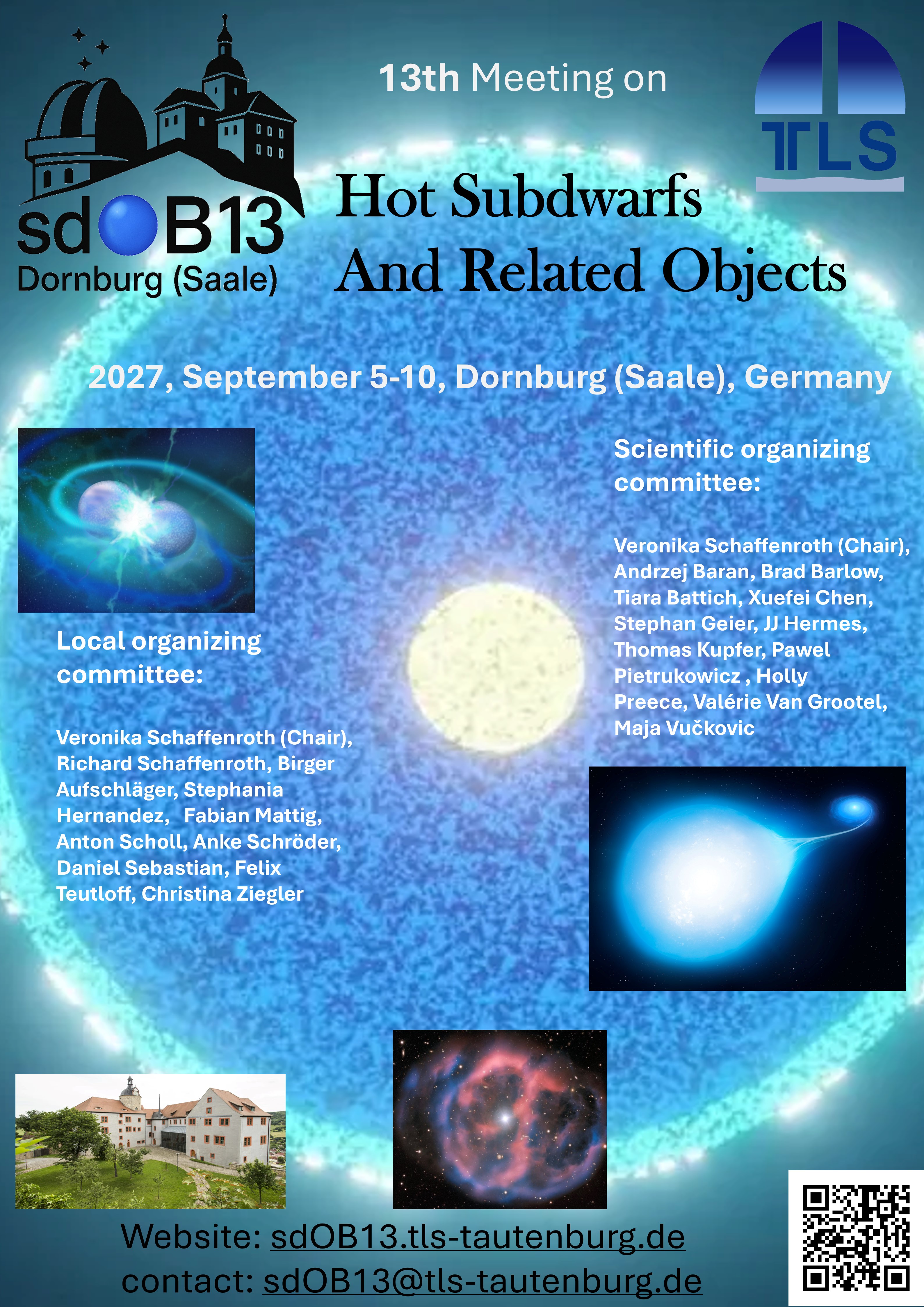
Organizing Commitees
Scientific Organizing Commitee (SOC):
Veronika Schaffenroth (Chair), Brad Barlow, Andrzej Baran, Tiara Battich, Xuefei Chen, Stephan Geier, JJ Hermes, Thomas Kupfer, Pawel Pietrukowicz, Holly Preece, Valérie Van Grootel, Maja Vučkovič
Local Organizing Commitee (LOC):
Veronika Schaffenroth (Chair), Richard Schaffenroth, Birger Aufschläger, Stephania Hernandez, Fabian Mattig, Anke Schröder, Anton Scholl, Daniel Sebastian, Felix Teutloff, Christina Ziegler
Past sdOB meetings
- 2025 - sdOB12 - Little Switzerland, NC, USA (Host: B. Barlow)
- 2023 - sdOB11 - Armagh, Northern Ireland, UK (Host: S. Jeffery)
- 2022 - sdOB10 - Liege, Belgium (Host: V. Van Grootel)
- 2021 - sdOB9.5 - Zoom/Potsdam, Germany (Host: S. Geier)
- 2019 - sdOB9 - Hendaye, France (Host: S. Charpinet)
- 2017 - sdOB8 - Krakow, Poland (Host: A. Baran)
- 2015 - sdOB7 - Oxford, UK (Host: A.E. Lynas-Gray)
- 2013 - sdOB6 - Tucson, Arizona, USA (Host: E. Green)
- 2011 - sdOB5 - Cape Town, South Africa (Host: D. Kilkenny)
- 2009 - sdOB4 - Shanghai, China (Host: Z. Han)
- 2007 - sdOB3 - Bamberg, Germany (Host: U. Heber)
- 2005 - sdOB2 - La Palma, Canary Islands, Spain (Host: R. Ostensen)
- 2003 - sdOB1 - Keele, UK (Host: Pierre Maxted)


